
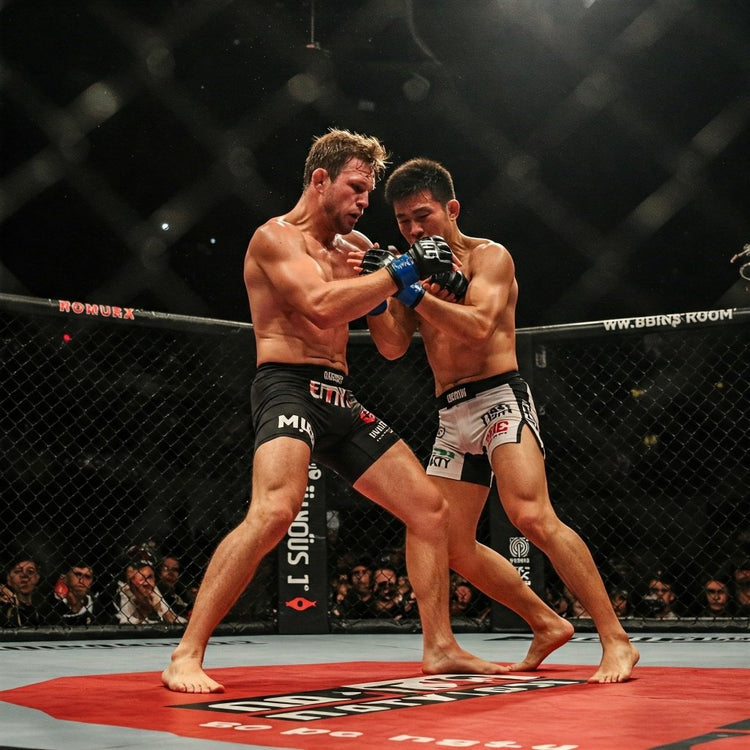
🥊 The rise of MMA: How mixed martial arts conquered the world
MMA (Mixed Martial Arts) is no longer a niche sport. It has grown into a multibillion-dollar industry with fans worldwide, spectacular fights, and unprecedented media attention. What once began as an underground fighting competition is now a legitimate and respected sport in which athletes from different disciplines face off in the ultimate battle.
But how did MMA become so big? What factors contributed to the sport’s explosive growth? In this article, we’ll take a deep dive into the history, rules, iconic fighters, and future of MMA.
Are you ready to discover why MMA is the martial art of the future? Read on and dive into the world of Mixed Martial Arts!

🥋 Introduction to Mixed Martial Arts (MMA)
MMA is a combination of fighting styles in which athletes use techniques from boxing, kickboxing, Brazilian jiu-jitsu, wrestling, and karate, among others. What makes MMA unique is that there are almost no restrictions on which techniques you can use. This creates a complete and realistic fighting system that forces fighters to excel in every aspect of fighting.
💡 What makes MMA so popular?
- ✔ Realistic fights → MMA is the ultimate test of fighting skills.
- ✔ Multidisciplinary challenge → Fighters need to be good at both stand-up and ground fighting.
- ✔ Spectacular knockouts and submissions → Fans love the excitement and unpredictability.
- ✔ Global stars → The UFC and other organizations have turned MMA fighters into superstars.
👉 Current trend: More and more recreational athletes are training in MMA for fitness, self-defense, and strength building, without actually stepping into the cage.
📜 Historical background of MMA
Although MMA exploded in the 1990s, the sport’s origins go much further back.
🔹 The first MMA fights
Pankration (Ancient Greece) → A combination of wrestling and boxing, used in the Olympic Games of 648 BC.
Vale Tudo (Brazil, 1920s) → No-rules fights in Brazilian arenas, where Jiu-Jitsu and wrestling dominated.
Bruce Lee’s Jeet Kune Do (1960s) → Lee believed fighters should mix styles instead of sticking to just one.
👉 Fact: The first modern MMA fights took place in Japan (Shooto, 1980s) and Brazil (Vale Tudo).
🏆 Evolution of MMA rules and regulations
In its early years, MMA was often seen as extremely violent and unregulated. There were almost no rules, and early UFC fights had no weight classes, gloves, or time limits.
But the sport evolved quickly and became more professional, with rules that protect fighters and ensure fairness.
🔹 Important rule changes
✔ Weight classes → So fighters face opponents on equal terms.
✔ Gloves required → To protect the hands and face.
✔ No attacks to the eyes or neck → To prevent serious injuries.
✔ Five-minute rounds → Ensures fair and controlled fights.
👉 Latest trend: MMA organizations are investing more and more in fighter safety and medical checks.
🏛️ The rise of the UFC
The Ultimate Fighting Championship (UFC) is the world's largest MMA organization and the driving force behind the sport's popularity.
🔹 How the UFC changed MMA
✔ Legalization of MMA → Rule changes helped the sport gain worldwide recognition.
✔ Strong marketing and promotion → The UFC built superstars like Conor McGregor and Khabib Nurmagomedov.
✔ Major events and pay-per-view → Millions of people watch UFC fights.
👉 Fact: The UFC was bought for $2 million in 2001 and is now worth more than $10 billion!
🔥 Key figures in the development of MMA
Over the years, legendary fighters have shaped MMA into what it is today.
🏅 Iconic MMA fighters
🥋 Royce Gracie – The pioneer of Brazilian jiu-jitsu in the UFC.
🥊 Conor McGregor – The first fighter to hold UFC titles in two weight classes simultaneously.
🤼 Khabib Nurmagomedov – Undefeated champion with a dominant wrestling style.
👊 Jon Jones – One of the most well-rounded MMA fighters of all time.
👉 Latest trend: MMA fighters are now building large personal brands on social media, boosting their popularity.
🥋 Popular MMA martial arts and techniques
To succeed in MMA, a fighter must master multiple disciplines.
🔹 Top MMA martial arts
✔ Brazilian Jiu-Jitsu (BJJ) → The king of ground fighting.
✔ Kickboxing & Muay Thai → For deadly kicks and knees.
✔ Wrestling → For dominance on the mat and takedowns.
✔ Boxing → Fast punches and defense.
👉 Current trend: More and more MMA fighters are incorporating karate and taekwondo for unpredictable kicks.
🌎 MMA's growth and popularity worldwide
MMA is growing explosively, partly thanks to social media, streaming services, and new markets such as China, Russia, and the Middle East.
🔹 Why is MMA growing so quickly?
✔ Accessibility → Anyone can follow MMA via YouTube, UFC Fight Pass, and ESPN.
✔ More training opportunities → MMA gyms are springing up worldwide.
✔ Celebrities and influencers → Fighters are becoming global stars.
👉 Latest trend: Influencers and celebrities are trying MMA, making the sport even more popular.
⚖️ Controversies and criticism surrounding MMA
Not everyone is a fan of MMA. Criticism focuses mainly on safety, regulation, and its influence on young people.
🔹 Common criticisms
❌ "Too violent" → Critics think MMA is too brutal.
❌ "Too much trash talk" → Some fighters promote fights by picking fights.
❌ "Unfair pay" → UFC fighters complain about low wages.
👉 Current trend: More MMA organizations are increasing fighter pay and investing in fighter safety.
🚀 The future of MMA: Trends and predictions
MMA will continue to grow and may become even bigger than boxing.
🔹 What can we expect?
✔ More international competitions → Asia and Africa are becoming new hotspots.
✔ Technological innovations → AI and data analysis improve training.
✔ Better fighter pay → Fighters will be paid better.
👉 Fact: The UFC is organizing stadium fights in new markets such as Africa and India.
🎯 Conclusion: MMA is here to stay
MMA is the fastest-growing martial art in the world. Thanks to strong marketing, spectacular fights, and unparalleled diversity, the sport will only get bigger.
💡 Are you ready to step into the world of MMA? 🥋🔥